You cannot spend 6 weeks overseas and not make some fabulous friends along the way.
Djazz, Laura, Ming-Loo, Nina and me = the lunchtime crewJasmine – who without fail always had a beautiful smile on her face.Lisa – the only pharmacist in the group. Come to think of it, Lisa was the only quiet, classy lady, in the group 🙂
What friends do when their pals are cold, take a cheeky photo, then plaster it on their blog 😉 Riding on an elephant with this lovely lady will always remain a moment of joy. Bestowing gifts and celebrating brothers day with these crazy fellas – Piers and Jack. The festivals creative directors = Piers, Uma and Zoe.
Bring nationalities together over pizza 🙂
Happy hour = Djazz, Laura, Ross and Ewan. The sensible ones of the group = Ros and Me 😉 Rasmila – what can I say, just seeing this photo of her makes me grin. She is a kindhearted lady; whenever we were on shift together, without fail, she always asked me if I was okay. When I think of my first day at the hospital, and how I was welcomed into the team, its this lady who I think of, she is a star 🙂 Amazing doctors who I will never forget 🙂 wonderful nurses who I hope to see again 😉
However it was the week in the village that my friendship with Djazz, Laura and Djazz formed a whole new level. I have some very fond memories of our crazy antics – painting Djazz’s face with Laura’s pale foundation, then laughing uncontrollably because of the difference in their skin tone.
Djazz chasing a baby mountain goat to make me smile and so they could all laugh at me saying “baby mountain goat” in a gruff Nepali voice.
Random conversations about having nipples like coat hooks because it was so cold, sorry folks if you were hoping for a photo you are out of luck, laura on the other hand will be pleased that we never captured her in a state of undress 😉 While all this was going on there was me shouting quick reach for your sunglasses, if Laura turns around she will poke your eye out, and Djazz shouting out something just as hilarious and equally as rude, as he poked his head around the curtain, knowing that Laura was now dressed, but pretending that he was hoping to see her with her top off. Even writing this I am laughing, those were fabulous moments & moments I will always treasure. It’s what I believe helped form our crazy, but much appreciated, fabulous bond, and very much what I need when I was reflecting on the culture, which was quite often, and I was reduced me to a sobbing wreck. Without these guys I don’t know what I would have done. Similarly when I was freezing cold and couldn’t get warm who did we call upon – the dutch blanket of course! Djazz and his techni-coloured yak coat would cuddle up beside, or on top of you, and within minutes you were melting like butter on hot toast 🙂
The hardest part was going for our final meal, a Tibetan Hot Pot, which was absolutely divine, and knowing that the next day I would be saying goodbye :((
mind you I did have to travel with one of them….Ros 🙂 who after one gin and tonic and a swig of red wine was 3 parts trollied and giggling like a schoolgirl who had stolen the homemade wine.
I did like life in the village, even my though I found it rough at times, the host family were amazing and I feel very blessed to have been given them opportunity to live with them. They were incredibly friendly, always keen to talk, so that both parties could improve their understanding of a new language, and they could sense when the other villagers were being too pushy or over excited and would tell them to calm down, or go away.
Grandma – full of mischief even though she was in her 80’s
Sharing flowers on a sunny day
But there were some draw backs. The lack of bathroom facilities. How I missed being able to have a nice warm shower 😦 I have never felt so dirty in my life, and while I did wash my hair every other day in cold water, thats how drastic it was, I used cold water, I craved having a hot, soapy shower. All I can say is the whole experience did not bode well for my OCD.
There was also the issue of mealtimes. However, this was good for my waistline 😉 Most of the meals were dhal bhatt, and even though this culinary creation was better that the dhal bhatt I had tried in Kathmandu, which I am sorry to say I can only describe as tasting like a bowl of warm vomit, at mealtimes I struggled to eat more than half the rice on this plate.
However, when my host family realised I was not eating they did try very hard and they did produce a delicious bowl of spicy noodles. In fact they were trying so hard to please us that one evening they offered us goat . Having been married to a butcher, the thought of goat was fine. After all its what you eat if you go to Turkey or Greece, they might sell it to you on the menu as lamb, but i bet your bottom dollar its kid/goat meat. However, when I realised where the goat was coming from I had a change of heart. I just didn’t like the thought of an animal being taken from the field right beside me, then slaughtered for tea. All of a sudden I was saying its okay we can eat veg tonight, honestly I don’t mind. Sadly this fell on deaf ears and the mountain goat met its end. Despite hearing from Djazz and Laura that the whole process was very quick and humane, I was very grateful that Ros, and Djazz were happy to discreetly remove the meat from my plate, and promptly devour it, so that I did not to offend my host family.
Saying all this, I did appreciate that this was an incredibly kind offer and not something they would do for everyone who is a guest in their home.
The final thing that I did not like, and what made me cry several times, was seeing unkempt children. Now I’m not saying that all of the children were neglected or living in abusing conditions. Because that’s not the case. Some children just wore dirty clothing because they have limited clothing and the parents don’t see washing your clothes as important as you and I, and children had dirty hands and faces because they play, with their siblings and a piece of wood, on the land.
When I think of the children that stole my heart, besides Ritika, and that was because she was sooooo adorable
there was only one other child that I could have taken home and that was because I have never smelt a baby that smelt so offensive in my life.
The poor little mite didn’t stand a chance, she was wearing filthy clothing, had the dirtiest face I have ever seen, had lice infested matted hair and at 9.00am was being breastfed by a drunken mum 😦 To top it off, when I asked Sanjay to ask the mum if I could hold her baby, she said to Sanjay tell her she can keep it, but I want it back when she is old enough to work. Initially I thought she was joking, but the look on Sanjay’s face and our host mum’s face said it all, she wasn’t, she really did not want this child. How sad is that, growing up knowing, or having that feeling that you are unwanted or an inconvenience. Trust me if I could have brought that child home I would! Even though I do have some reservations about adopting from overseas, mainly because I think its wrong to take a child from their own family and culture, this was a moment when those thoughts went completely out the window. To be honest this little one has been on my mind since coming home, and I have looked at the governments website about adopting children from Nepal. Sadly the UK has restricted adoption from Nepal. Due to concerns about the lack of support for birth parents, and about the legal effects of relinquishing their child for adoptions. Also there are no procedures in place should the child wish to find/contact their birth parents in the future, a lack of transparency and accountability for money that is exchanged, and a high prevalence of falsified documents.
Village life is quite simple, children who play happily with a skateboard that is handmade and from a plank of wood.
families sitting outside their homes in the afternoon sun
Those who are working on the land and those who kindly invite you into their homes, put you first, and would share their last scrap of food.
I wish I could define a moment that has made me fall in love with Nepal, but I have had so many wow/highlights that it is impossible to chose. The views were spectacular
and I will never forget the genuine kindness and generosity I experienced during my time in the village. From the moment we arrived we were treated like one of the family, and there was not one moment where I did not feel that I was not welcome in their home. Having fun with the children, such as showing them how to use an English tea set, and teaching a young girl a hand clapping game
will always stay in my heart, and completely override the fact that that, at times, I missed my family and home comforts 🙂
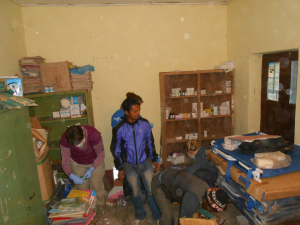
When Andrea see’s a room that looks like a tip, yet has a heap load of equipment/medication that can be used, and she knows she has a few days here and some fabulous friends to work with bibbidi-bobbidi-boo: salagadoola menchicka boola bibbidi-bobbidi-boo put ’em together and what does she suggest… yep you got it, cleaning this room, getting the stock in order and whipping it into shape 🙂 and as soon as the words flowed out of my mouth Djazz said Yep, thats exactly what I was thinking as well 🙂
The only thing I had not banked on was the fact that the room contained Cinderella’s rats :o, and when we started to move school jumpers, that had been donated from overseas, we must have disturbed the little fella, actually quite fat fella, from his slumber. Upon seeing him dart toward me I screamed, ran from the room, then jumped on a chair, still screaming OMG, there’s a rat! Despite me screaming and running, from the room the local children ran into the room at high speed; when I question why they chose to do the opposite, all I can think is that they thought they were missing something!
Referring to my previous post, where I was so angry I hopping like a frog, seeing aid from overseas not being utilised made me feel that what we were offering was not being appreciated. Medication was untouched/unboxed, left to go out of date, and school provisions were either rotting in the damp storage conditions, or being ruined by rodents. This made me really mad. So I piped up, asked what was going on, and said how this discovery made me feel & thats when I found out why the school shoes, jumpers, and equipment had not been given to those in need. Sanjay, explained that they did not have enough enough for all the children, so were waiting for more donations before they shared them out. They also thought that it was unfair to share them out at this point as they knew how excited the children would be and some children would be devastated if they were sent away empty handed. While I could see the rationale behind this, it it didn’t deter me from suggesting that these gifts should be distributed now. The weather was cold, the temperature was dropping fast, fuel was scarce, there had been an increase in chest infections and pneumonia, and children’s health was at risk. Whats more if they left it any longer the clothing would be ruined, as rodents were nesting in them, and they before long they would have nothing to hand out. A point of view that Djazz agreed with, so together we decided to reiterated our opinion to Sanjay and hope that he relayed this to the head teacher. Guess what, to our surprise, it worked! The next day, while at the health post, we found the children all lined up waiting patiently for shoes 🙂
okay some children were given a pair of shoes that I doubt they will ever grow into, but nevertheless, there was a very excited bunch of kiddies waiting for a pair of, very plain, black shiny school shoes.
I think the saddest comment I heard about not handing out the school wears was – westerners would come to the village, see that the children had shoes, and jumpers, and might stop sending aid as they thought everything was okay. How heartbreaking is this 😦 It’s like they have developed a coping strategy to prevent knock-backs, they are too scared to openly enjoy basic provisions in case they don’t get given anything else. As much as I felt for them, I did present them with another angle – if donating countries found out that their gifts were not being used they might not send anymore, they might adopt the approach well if they can’t be bothered to help themselves and appreciate what we send whats the point of sending more. While the latter angle might have sounded harsh, I hoped that they took it as it was intended and I hope I spoke words that others in UK would have felt- we would rather see you you using donations & that its been greatly appreciated, but now needs replacing, than hearing you have left it left to rot.
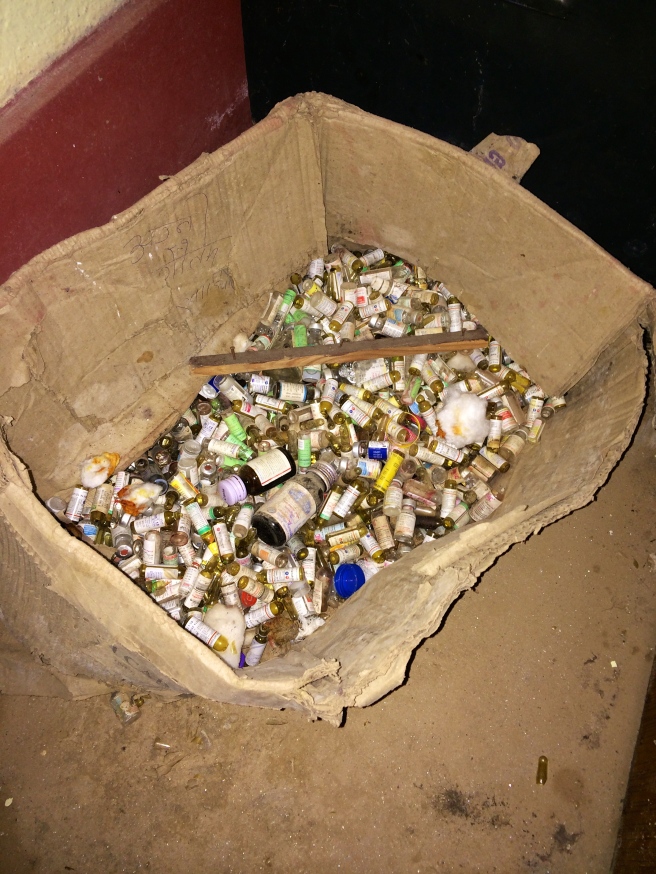
Similar words, to the clothing, was also said when we discussed the fact the medications had not been unpacked, medications had not been properly rotated, and that so much medication was now unusable as it was well past it’s expiry date.
medication that has expired
Don’t get me wrong, I know that some of the medication did not arrive within date, but we did discover boxes and boxes of medication that in unmarked, sealed cardboard packaging, so it was evident that these provisions had not even been looked at. Had Djazz not gone hunting, and we had not embarked on our Cinderella expedition, these medications would still be lying untouched. Grrrrrrr, that makes me hop! However, by the end of our bibbidy-bobbiding, everything was in an organised fashion, on the shelves. All stock was in correct date order, and staff had been informed what medications went with different conditions, so they had no reason to turn patients away or say that they had limited drugs. In fact when we looked at the list of medication that was hanging in the consultation room, after sorting through the store room, the only medication that the healthcare post did not have was oxytocin, ringers lactate and gentamycin.
Even though the discovery of so many drugs cheered us up it did make us question if donated medication was sometimes sold on the black market, and if it was it, it was easy to see why someone would be tempted to do it. Many people in the region of Sindupalchok are living in poverty, it was one of the worst-affected districts as a result of the earthquake, and because of the fuel crisis, and border being blocked into India, medication is scarce so a quick way to make money. Especially if you know that you have multiple medical and nursing students coming into your village with an endless supply of medication. I know this doesn’t paint a pretty picture, but thats how life is when you a country is unstable & you are destitute, systems become corrupt, as you fight for survival. Corruption and bribery is not limited to Nepal it takes place around the world and no country is immune, you just have to look at Forbes website to see the top ten the list corrupt countries in the world. Actually, when you do look at it Nepal isn’t even listed. However, I did discover an article about Nepal’s medical education system. This is what it said –
Allegedly Nepal manufacture fake doctors, and is infested by corrupt investors with political protection. The registration of medical colleges is a convoluted process in Nepal, but it can be made much simpler by bribing a thoroughly corrupt system. The reporter, Ramu Sapkota, for the Nepali Times also claims that his investigation also revealed a chilling truth: almost everything is for sale in Nepal’s medical education. Nearly everyone is on the take: government ministries, the Nepal Medical Council (NMC), even the anti-corruption watchdog, the CIAA, and Supreme Court. Anyone can be a doctor if you pay someone enough. Bribery is standard operating procedure in acquiring college licenses, student seats, manipulating monitoring teams, influencing the judiciary. The medical mafia will even guarantee that students with cash will pass not just their entrance exams but their final exams too.
My take on corrupt Nepalese doctors – while I was at the Teaching hospital I saw no corruption at all. In fact all I saw was caring, hardworking doctors who paid a fortune for their education and when qualified got paid a lot less that we do in the UK. Whats more they exposed themselves to a multitude of life-threatening illness (on a daily basis) and hadn’t had a day off in months. Shame Ramu Sapkota hasn’t written an article about that 😉
I’m not going to lie, and it might have only taken 30 minutes or so, but the trek to the healthcare post was a killer! I’m just glad that I wasn’t banking on having a comfy seat when I got there, because seating was a wobbly wooden bench or a red plastic chair, kinda like the ones we use in garden many years ago. Saying that these seats did a fabulous job and, as a team that consisted of 1 student doctor, who we called the god king, and 3 student nurses, on our first day we managed to diagnose, and treat, 22 people 🙂 Yipeeeeeee. The range of illnesses :- COPD, sore throat, common colds, toothache, acid-reflux, and post earthquake/pain injuries.
Never in a month of sunday’s did I think that I would be using my dental nursing skills while in the Village 😮
upon inspection we realised we didn’t need a torch to see the cavity/infection 😦
However, I am very grateful to the dental professionals who helped me achieve my NNEBD qualification, and to those who helped enhance my skills afterwards. While in the mountains; 85 km from Kathmandu, these skills were invaluable and greatly appreciated by patients. On several occasions we were able to provide appropriate medication, and oral hygiene/ education advice. Don’t panic dental buddies, I wasn’t doing any illegal procedures, but as we didn’t have any dental instruments, after removing the needle, and then reassuring the patient that it had been removed, we were able to improvise, using the end of the syringe to tap on the tooth and isolating the tooth that was hurting.
my look of concentration 😮
Before I go any further, I would like to say, thank you to Djazz, he was a star, if he is reading this I bet he is nodding and saying something like yes, I am the almighty chosen one, I am really pleased he was with us when we purchased medication in the village at the foot of the mountain. It was his knowledge of international drug names and the classified groups of antibiotics that enabled us to have a wide range of medications, it was his knowledge of dosages, side-effects, considerations and interactions that enabled patients to be prescribed the correct medication, and it was his knowledge, not forgetting his patience, fabulous attributes that he warmly, and openly, shared with us every-time we treated a patient.
To given you an idea of how the earthquake affected this region when the earthquake occurred steep mountains and narrow roads in the Sindhupalchowk district drastically slowed rescue efforts. Residents were isolated and it took vehicles over 3 hours for vehicles to arrive in Mankha from Kathmandu, and out of the 66,688 houses in the district of Sindhupalchowk 64,565, or 96.8%, were destroyed. Priorities that have emergered for humanitarian interventions are – shelter, food, health, and water.
Shelter:- The level of damage increases higher up the valley, Prior to the earthquake 92% of house’s in Sindhupalchock were made of mud-bonded bricks or stone. Now, families are living outside their homes under makeshift shelters of old tents, plastic, bedsheets, bamboo, corrugated iron, or wooden boards. When you compare this information to our accommodation, even though it is very basic we do consider ourselves to be very lucky. We have a corrugated iron shack, with raised wooden beds, and fabric that acted as an insulating roof.
our accommodation
Trust me, not even this type of accommodation is not enough. We knew it was going to be cold at night, but we were unprepared, we never expected the temperature drops so quickly at night, and even though I was wearing, 2 pairs of walking socks, a pair of leggings, 2 pairs of fleecy pj bottoms, a vest, a thermal base layer, 4 long sleeved jersey tops, a cardigan, a scarf, and a windstopper to bed, I was still feeling the cold.Every day when we spoke to the villages we considered ourselves lucky – we are able to layer up, wrap up in thick blankets, and not be exposed to freezing temperatures, wind, and pressure, unlike those who had to grin and bear it.
Food – 45% of the population were estimated to be living below the poverty line, and in some areas, especially mountain zones, people do not have easy access to markets and are largely dependent on their own produce. However, foods stocks have been significantly impacted and are limited because they were unable to harvest during the months of May to July.
February to April is generally the lean season, during which people rely on the las harvest that occurred around october to November and food stocks start to get low, while awaiting the next harvest in May to July. Which also means prices of certain foods have doubled post-earthquake.
corn drying in the rafters
Health:- Prior to the earthquake supplies, staffing levels, technical, and infrastructure conditions within the only hospital in the districts capital Chautara, were dangerously low. Whats more, healthcare posts were also understaffed and relying heavily on overseas aid to provide medication for people in remote areas. When you combine the pre-earthquake healthcare situation with the current political situation, a lack of fuel, the situation here is really concerning. Especially when you are hear that the since the earthquake,in mountain regions, there has been a marked increase of pneumonia, diarrhoea, and because of injured people, infected wounds and skin conditions people need instant access antibiotics so that, wounds and bio-medical conditions, do not become septic,which could cause more deaths.
Water:- In some villages there is no access to safe sanitation and soap. This little girl was having her first hair wash with shampoo, I have never seen a child so excited about washing her hair in a bucket of luke warm water and bubble bath. The water was only heated because they know thats what westerners like.
Those villagers who are lucky enough to have a latrines will often share it with the majority of residents in the neighbourhood.
Safe drinking water is also questionable, villagers source their own water supplies & fix it when it becomes broken, so there is always the risk of an outbreak of water-bourne diseases, including cholera and dysentery.
water supply – a pipe that has has been connected to the natural water supply by lodging it in a mountain crevice. Little girls playing with a plastic tea set.
Especially when people are living in close quarters, defecating in the open, living in close proximities to domestic pets and livestock, and have contaminated water.
Given this knowledge, when people arrived at the healthcare post complaining of D & V I listened carefully to every case and if I was worried that if patients were experiencing the same symptoms, or had been unwell for the same time scale, I made notes on my phone so I didn’t lose track of what had been said. The reason being, if there was an outbreak we would need to act swiftly, to access additional medical support, and, if need be, inform the authorities that the village had become an endemic area, thus protecting other lives.
Bearing that we had to be on the ball about all of the above information, and think on our feet about new information, even though we had a translator, at times trying to effectively communicate with our patients was incredibly frustrating. Very often specific words or whole sentences got lost in translation. This is not a criticism of our translator, this was Sanjay’s first job as a medical translator and tried incredibly hard, but when you had missing information, you could not build a bigger picture as you could not tease out intricate information and ultimately you were unable to make a safe diagnoses. Sadly I have to confess, despite good intentions on occasions the high standard of patient care we wanted to deliver did waiver. Regarding the language barrier I’m just glad that we had the option to partake in language lessons each week, and we had spent 5 weeks in Kathmandu learning from staff at the hospital. This time really helped me with basic communication, and even though I didn’t attend all of the language lesson (because it was such a fast pace I got confused) I did pick up a some key words and phrases which was advantageous during healthcare posts consultations.
The healthcare post was, ummmmmm, yep you guessed it, sadly it was dirty 😦
Cross-infection control was nil; I doubt that the stethoscopes, blood pressure cuffs or thermometers got disinfected in-between the handful of students that attend the healthcare post, and If you wanted to wash your hands at the sink you had to use bottled water as the sink had not been plumbed to a water supply. However, within 2 days, this healthcare post had been swept and cleaned like when Cinderella swept the halls, stairs and terraces before she went to the ball, but thats another story I will tell you about later on 😉
Another observation was the patients the waiting room doubled up as the consultation room and unless you had an intimate problem, which by now everyone in the waiting room would have heard you describe, you wouldn’t get taken to the room next door that housed a dilapidated, dusty clay covered, bed.
Regarding the state of the bed – before a patient climbed up onto the bed you had to pull the the bottom of the bed towards you, very firmly, to stop the legs at the other end collapsing. Obviously when we arrived we were not partial to this information, and when a patient hopped up onto the bed, the head end tipped up and the patient was almost catapulted through the air. Looking back on it, its really funny, but at the time we were all mortified, despite the patient seeming unfazed. Comparing this scenario to life in the UK, can you imagine would happen if this happened at a local healthcare facility?!? Within moments it would be all over Twitter and Facebook. The local newspaper would have contacted; they would have concocted a snazzy slogan and plastered it all over the front page.Your manager would have called you in for a meeting, given you a warning, or worse still, suspended you while an investigation was pending, informed your professional body, and your career could be on the line. A risk assessment would have been typed up and those really annoying, so-called, accident claim experts would be on speed dial with advice about personal or injury compensation. Whereas in Nepal the chap giggled, readjusted his hat, told us about his complaint, was given his medication and thanked us profusely for providing free healthcare. How I wish this common-sense attitude was still the majority in the UK.
The part of the healthcare post that annoyed me. In fact I was so enraged I was hopping like a frog being chased by a lawnmower! When we arrived we were told by the healthcare assistant that they did not have any antibiotics and the situation was dire. However, this information did not sit with the information we had gathered in Kathmandu. Prior to coming to the village, Djazz had spoken with Zoe, Ross, Jack and Piers, the students who had left only a couple of weeks before; he had been told that they left the healthcare post in good supplies, what medication they they used the most, and what we would need to take with us. So, Djazz went on a mission, he looked around the building, then asked the healthcare assistant for the keys to open the other rooms that were locked. This is what he found 😦
Aid from overseas that had been dumped in a room and hadn’t even been unopened. What we did follows in another mahoosive blog, so get another cuppa ready. Cinderella, we have just stole your job 😉
Our journey began when Sanjay, our guide and translator for the week, picked us up at silly o’clock in the morning & took us to the bus station in Kathmandu. Now I know this probably sounds a tad crazy but I was excited about finally having the opportunity to travel on public transport. Okay, lets re-phase that a bit – I wanted to pick and chose my experience 😉 I wanted to experience the culture – join in with Joe Bloggs, and sit beside a baby mountain goat, when the bus was cramped, not sit on the roof of the bus, for hours on end, when the bus was chockablock.
Now I know this bus looks a tad battered, but we figured if we were travelling on this Number 17, it was, most definitely, going to be the safest little bus. Our rationale – it’s bumps and grazes proved that it knew how to handle oneself on the busy streets and mountain passes of Nepal, whereas the posh shiny, un-scuffed buses, were new therefore, had no experience, and were more likely to topple over on a tight mountain pass 😉
The journey took approx 4 hours, with about 4 stops in-between, and I thoroughly loved it! In fact, when street traders jumped on the bus trying to sell passengers oranges, nuts, vegetable, samosas or genuine fake designer gear, I spent a lot of time looking like a tourist, because I could not stop grinning like a cheshire cat.
Oranges & Roasted Nuts Peddling their wares 😉
Whats more I must have felt safe, as once out of the city I soon fell asleep 🙂 However, I did have a little shock when I woke up, Ros, who had been sitting beside me, was gone! Instead of my familiar friend being thigh to thigh with me I now had a little boy, aged about 18 months, rubbing my knee, and an elderly lady cuddled up next to me smelling like a box of Twinning’s, smokey, Lapsang Souchong tea. To start with I thought Ros had left me on the bus, but when I spotted Djazz and Laura still in the seat in front of me, Phewey !!!, told them what had happened, and we had finished laughing about my moment of panic, we all came to the conclusion that Ros had been Ros, her usual kind self, and given up her seat. Can I just add – If you wondered why Ros and I were up-close in the thigh department, its not because our friendship had reached a whole new level, that came later on in the week 😉 its because,quite frankly, bus seats have been designed for delicate derriere’s, not western ladies slightly bigger posteriors 😉
Our final leg to the village was via a jeep, Ros, Laura and Djazz in the back
and because I was the tubby one of the group; would take up more room, I got the front seat. Now I know that bagging the comfy front seat sounds like I had the best deal, but for the first time ever, even though I am under no illusion that I am a skinny bird, I felt what it is like to be ridiculed for being overweight. The driver, and his mates, verbally, even though I could not understand them, and non-verbally made it perfectly clear what they thought about my size, in fact they were so rude that their behaviour reduced me to tears. Like I said, I know I have scoffed too many biscuits, but this experience has given me a new empathy. Many times I have been on a ward and heard nurses openly say a patient won’t fit in a chair, needs extra staff to move them, or needs specialist equipment ordered because they are severely obese and require bariatric care, but not once, and believe me I see my massive short-fall here, I have never voiced my disapproval at their choice of wording , or advocated for my patient when I thought their mannerisms were insensitive. On this note, all I am going to say is, this moment/encounter will never be forgotten, its dehumanising, nobody deserves to be treated in this manner, and even though I will elegantly challenge the perpetrator woe betide anyone who does it on my watch.
Regarding the driver and his pals, I don’t think they did it in malice. Nor do I think, even though I gave them the Ondrea is unimpressed with you/ chuff off look, that they gave their behaviour a second thought. Instead, I think they got caught up in the moment, made a spur of the moment comment and forgot that even though I did not understand their verbal words, their non-verbal communication spoke a thousand words.
Even though I perceived this behaviour as inappropriate/not politically correct/ offensive, I am not naive, I know this sort of behaviour occurs regardless of where you live in the world, and does not represent the attitude of all Nepali people. Whats more I am equally aware some people would like to high-five these guys, as they believe that our attitudes are mamby-pamby, that way we speak so we do (PC) so we don’t offend weak people, or that don’t have the gumption to say what they really think or feel, and in some cases I do agree with this stance. However, not on something of this nature.
When we arrived at the village, we were greeted by our host family, and what seemed like half the village, and in true Nepali tradition we took it in turns to have our foreheads anointed with the Nepalese tikka (a mixture of red dye and rice).
Within moments of being anointed we were informed that a wedding was just taken place and that the father of the bride had asked if we would like to attend, and bless the newly weds. Obviously, we all said yes, for one, it would have been rude to refuse such a generous invitation, and two, I had seen wedding parties on the streets of Kathmandu; was itching to see the bride and grooms outfits and appreciate a new custom. While bestowing our blessing, which consisted of placing tikka on the bride and grooms forehead, then giving a gift in the form of money, I was totally wrapped up in the jubilation.
It wasn’t until I thought heck they look young that I asked Sanjay, our guide, how old they were; when he replied 15 and 16, I could not contain my shock. I know that my facial expressions said it all, also I know that I blurted out “oh my god, they are still children, is that normal practice in Nepal?” It was at this point Sanjay relayed a discrepancy in our cultures. It was an arranged marriage, they met for the first time that morning, and the bride would be expected to leave the village; move in with her husband and in-laws, and now abide by her new families rules. Sanjay also said that arranged marriages, at this age are illegal, however, due to a range of factors such as preserving wealth, family reputation, family pressure, strengthening family links, preserving land, property, or caste, lots of underage marriages still take place. Furthermore, parents, or grandparents, may have made a promise to another family when their child was young and even though their circumstances or beliefs may have changed over the years, such as they don’t feel the same way now, they feel they can’t let the other family down. Their rationale being, it would bring shame to them, so they have no option but to honour a long-standing family commitment, despite the grief, hardship, it may cause.
To be honest, hearing this shocked me. Actually if I am being brutally honest I felt sick and hours later, when we were on a walk, Sean, the manager from work the world phoned, asked me if I was okay and I burst into tears. I told him I hated it in the village and wanted to go home. The whole experience made me feel that that I had contributed to a ritual that ethically was wrong, and no matter how hard I tried to shake this feeling, negative thoughts kept rushing through my mind. They were both children! Youngsters who should be having the chance to have an education, develop their personalities and sexuality (as they might not be heterosexual) and have the opportunity to travel outside the village to experience/ learn, what life was really about. Not having a marriage, and a future, all mapped out for them by family members who, despite thinking they had acted with good intentions, might have got it completely wrong, and I hope that this the following didn’t occur, that they might have emotionally blackmailed or physically threatened them if they said no. Knowing that the young bride was about to leave her family, would have a lack of family support and no-one to turn to should she feel isolated, frightened, lonely, withdrawn, made me want to scream with frustration. Whats more I felt helpless, I could see that statistically, because of seeing so many young people attending the teaching hospital’s emergency department after attempting to take their own life, that because arranged marriages encounter many problems both of these young people could suffer with mental and physical health problems, such as depression, eating disorders and self-harm. Yet I was powerless to help, or intervene, as within this community I was seen as a guest, therefore should respect their wishes. Also, as far as they were concerned they had done nothing wrong.
Boy, oh, boy, oh, boy! I knew this week was going to test me but I never expected it to be so bloomin challenging on the first day. It was this day that I was incredibly grateful I could text Alan, pour my heart out, and read some encouraging words.
Regarding bestowing the bride and groom with a monetary gift, traditionally the groom receives more than the bride, saying that it is also acceptable to give both parties the same amount, but this is where the hick up comes in. I didn’t have equal amounts but I was darned if I was going to give the groom the highest denomination of cash. After all in the Ward household there is the cheeky saying of whats yours is mine and whats mine is my own 😉 So in true Ondrea style I gave the groom 50 rupees and the bride 500 🙂 Don’t panic folks, I did check with Sanjay that this gesture would not compromise the brides safety & Sanjay reassured me that the families would respect my wishes. Whats more when I told Sanjay why I was giving the bride more he did said this gesture made him happy as, like thousands of other Nepali’s, he also believes that there should be no gender discrimination 🙂
When I started my Work the World / voluntary nursing fund raising, Sue, one of Alan’s work colleagues, who is also renowned in the UK for her involvement with the Mid Wilts scouts,very kindly asked her scout groups if they would mind donating toiletries. Then on the 7th November I packed them all in my suitcase, which I have to say weighed more than my make-up bag, trowel to slap on the face, and general stash of smellies that are used on a daily basis, and on behalf of Sue and the Scouts took them to Nepal to help those in need.
When handing these kind donations over , without a shadow of a doubt, all of those provisions were very much appreciated. In fact the maternity team were so overwhelmed with their large bag of goodies that they kept asking me if I was sure it was for them. Also they kept asking if I spoken to the nursing director and informed her that were meant for them/were allowed them. The reason being they hardly ever get donations like this, so it would be a real treat to provide their mum-to-be and new mum’s with free personal hygiene products, also they did not want to run the risk of having to share their goodies with anyone else.
Why this donation was so important – For most of us lovely ladies in the UK, around the world, and a proportion of the gorgeous girls in Nepal, personal hygiene products are a necessity. However, for some ladies sadly these items are a luxury, and although I was aware of this my rose-tinted spectacles wanted to me to believe that this only applied to a handful of the female population. Sadly while in the maternity department it soon became apparent how many ladies used pieces of material or quite simply went without. It was seeing this that made me think how I would feel if I had to spend my cycle of mother nature without those famous pads. Which are advertised as being able to cope with those extra-heavy moments, or having super-duper flexie-wings to hold them in place while dashing around. Mmmmmm, to be honest, I don’t like that thought, and despite text books informing young girls that menstruation is natural and healthy, for me, even though I am an adult, periods are just gross. Even the whole period etiquette – sends me into awkwardness. Periods should be totally private, zibang, end of! A tampon falling out of one’s handbag, a used pad discarded in a public toilet, a box of unused tampons in the bathroom, and seeing a box of them going down the supermarket conveyer belt, fills me with dread. So the thought of a menstruating women having to negotiate her time of the month with grace and aplomb, quite frankly sends me into a tizz. Now I know that some ladies will not share my anxiety, and will be shouting that asking for a tampon should be like asking for a pencil, sorry ladies I don’t feel the same way, and to be honest this blog is the biggest open-dialogue I have ever had about the time of the month. Guys, if you are still reading this ;), I think it is only fair to bring you into this discussion. After all, even though some fellas are happy to buy feminine products, there are a lot of guys also have the idea that menstruation is some kind of monstrosity. Even those tough guys who brag about their muscles, suddenly freak out when their partner is having a period. Given this, and not because I am trying to create, or attach, an unhealthy stigma to periods, or feminine hygiene products, I believe that all women should have the option having their menstrual cycle in private. So for anyone who is travelling to a developing country please bear this little blog in mind – Pack those tampons and pads in your backpack and take them to a healthcare post, or hospital, trust me there are loads of women who, like me, would be very grateful about protecting their dignity that month.
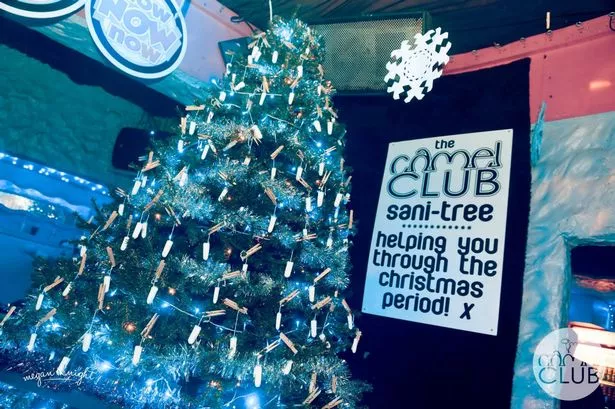
To add more horror, for ladies and gents like me, or humour to those who think a sani-tree would be empowering. How about a christmas tree adorned with tampons?!? After all they say its the most wonderful time of the …..month, and should help you through the christmas period! Yep, it might be the weirdest christmas tree in town; a feminist group have applauded the Huddersfield club saying that the tree helps to “normalise a part of nature that is often presented as vulgar and offensive”. Also it makes light of the recent tampon tax controversy where the Government eventually agreed to strap the VAT to sanitary towels.
Saying goodbye,and thank you, to the wonderful people I met was such an emotional moment, I lost count of how many times I had to fight back the tears. Especially when the nursing director, and fabulous girls I had worked with, presented me with a traditional scarf and handmade purse.
The words thank-you seem insignificant compared with the gratitude I feel. I truly do feel very lucky to have been accepted as one of the team, encouraged to share western perceptions about nursing care and equality, and supported while learning new clinical and cultural skills. I guess to sum it up I feel that I have met people who will always be in my heart. I also feel that I would like these incredibly hardworking, talented and professional ladies to have the same opportunity that I have had. Hence why I am going to approach my university and see if we could organise an exchange programme. I believe that an opportunity to shadow/work in the UK would not only provide a fantastic personal learning opportunity but it could also be the best way for healthcare experiences, and skills, to alter to in Nepal. My rational being – a visual experience, where you see your rewards, holds more emotional attachment than a theory you have learnt from a book. Similarly you are more likely to follow it through, make changes, and be able to articulate yourself if someone challenges you about it validity. Also because Nepalese nurses don’t earn anywhere near the same amount as we do, I would like to do some fundraising to cover the cost of their flights, visas, accommodation,meals, etc, so this opportunity becomes reality, not something that is” pie in the sky”.
In true nursing/ medical fashion to say thank you, and to make saying goodbye easier, we took in 2 very yummy cakes 🙂 Which greatly appreciated and devoured within about half an hour 🙂
From what I have seen in the last 5 weeks some attitudes of doctors and nurses at the teaching hospital are no different than those in the UK. Those that are try their hardest and work around the clock with little sleep (doing 3 or 4 back-to-back shifts and sleeping in the doctors room when time allows). Those that are emotionally burnt out but keep struggling on as every now and again their internal locus of control keeps electrocutes them, like when you touch the electric fencing in a cattle field, and they remember why they worked their socks off to join the profession. Those who are full of energy, seem thrive when pushed to their limits, and are combining continuous professional development/ academia with a full time-job and voluntary work, and finally those who have lost that care and compassion and make you question why they are still here. However, I have to say that when I comparing the latter attitude, to attitudes of healthcare staff who work in the UK, there was a huge discrepancy. In the 5 weeks I was in the emergency department I can only recall 1 person who gave the impression of not wanting to be there, whereas when I compare this to being on placement in the UK, on each placement I have found several people who are discontented and considering leaving the profession. While the lack of insight might have been because of the language barrier, I think it was down to the attitude/ resilience of Nepalese people, where they have a – its happened you can’t change it, so just crack on with it attitude. Even when I did ask staff how they felt about being exposed, and vulnerable, to life-threatening diseases nobody ever complained. Nor did they ever mention that health and safety bods, and management needed to get together; rectify the lack of isolation rooms available, so that patients were not infecting other vulnerable patients. It’s these amazing doctors and nurses are who keep the teaching hospital doors open, and I feel very privileged to have worked alongside them
Come to think of it patients don’t ever complain either, but this could be due to a lack of education and understanding. Alternatively their decision not to complain could be based upon the fact they would be complaining to a family member. In Nepal its the family who provide drinks and meals, take their loved one to the toilet, provide clean bedding, so complaining to a family member could be risky business, if you catch my drift 😉 I don’t think I would be brave, or stupid enough, to complain to my family if they had sat by my bedside for hours, days or weeks on end helping me with my daily living skills 😉 However, saying all that I would like to make it clear that in no way am I saying that any patient, family member or friend should have a reason to complain and no healthcare professional should ever ignore, or fail to provide a high standard of patient-centered care. Also it was failings in the above-mentioned provisions that have caused unnecessary suffering to hundreds of members of the public and hence why the Francis, and Winterborne, reports were compiled, and much needed, in the UK.
However, it doesn’t change the fact that a new mum, and her 3 day old baby were admitted onto an observation ward, this department consisted of approximately 30 patients, and illnesses ranging from viral meningitis, TB, COPD, D&V and the side-effects of partaking in a hunger strike. At no point did anyone question, or raise a concern that this infant was incredibly vulnerable and was being unnecessarily subjected to illnesses that could have serious consequences.
Or that this gorgeous little fella, who thoroughly enjoyed being entertained by my good old latex glove/ ballon creation ;), and his older brother spent 72 hours in the emergency department amongst patients with active TB while their mum was being treated for suspected kidney failure.
consent was gained from patient to publish photograph.
So come on folks, especially fellow health proff’s ;), why do we all complain about the following, what is it we are trying to achieve and are we going about it the right way
1) Our salary.
2) How the media and general public perceive us
3) The time spent on a never-ending trail of paperwork (mmmm, I think I can answer that, maybe its because we put in loads of effort and, sometimes, it never gets read again)
4) The hassle of raising a risk assessments,
5) Poor working conditions, insufficient nurse-to-patient ratio, lack of resources, professionals not working collaboratively, or general short-staffing?
6) Also why do some families fail to support their loved ones while in hospital, but when they do come in they then complain/ criticise our best attempts even though they know we are at our wits end & rushed off our feet or fail?
Don’t get me wrong I know we should be doing all of these things to protect our patients (put them first), adhere to NMC, NICE and CQC guidelines, and because we are accountable for our actions. But, yep there is always a but, sometimes when I reflect on how we behave at home I just want to scream with frustration. It makes me feel that by continuously protecting every move we make we are behaving in an over-the-top manner and that no matter how hard I try there is a chance someone will see me as not good enough and put in a complaint, or that if we request additional support to help us with our professionalism we end up being viewed as have perpetulant children who have thrown their toys out of the pram when it hasn’t gone our own way. Mind you we could adopt the Nepali way. When Nepalese staff are not being listened to, they just close the department, or go on a hunger strike. While it sounds extreme, it does has the desired affect, they get what they want. Also it makes me question our rationales – has our desire to inform and protect people inadvertently caused an adverse effect. Such as, we provided so much knowledge, so that people can make an informed consent, at times patients can tie us up in knots if they combine their perceptions with different protocols/legal angles, and if we don’t cover every angle we leave ourselves open to being sued and possibly struck off the professional register.
Reading this blog back to myself, in an attempt to identify my poor grammar, which I never can ;), my blog could been viewed as a rant, or me over-analysing everything. However, I would like to stress its not intended to be like that. Instead I like to think of it as research, or me elegantly challenging our practices and attitudes, so that I can appreciate a new perspective :)) So come on peeps, any feedback will be greatly appreciated. Also, thanks for introducing the elegantly challenging phrase into my life Mr Gagan, I love it, it gets me out of a multitude of scrapes, trials and tribulations 🙂
Giving birth here is a tad different than at home!
As you can see, even though I have blurred the patients face for confidentiality, the labour room has multiple beds, in fact there are 3, so it is possible for mums-to-be to have another mum-to-be beside her, with no privacy screen, while she is giving birth.
Even the clinical tools are a tad different than home – a home-made, corrugated cardboard, cervix dilation measurement tool. Which has been designed with good intentions and is just as effective, lets just not discuss the cross-infection risks.
Nepal’s most sacred Hindu temple, Pashupatinath Temple is situated on the banks of the Bagmati River, on the eastern ourskirts Kathmandu. Only Hindu’s are allowed to enter this temple, where Shiva is worshipped as Pashupati, Lord of the beasts.
Every year this temple attracts hundreds of elderly followers of Hinduism. They arrive here to find shelter for the last several weeks of their lives, to meet death, be cremated on the banks of the river and travel their last journey with the waters of the sacred river Bagmati, which later meets the holy river Ganges. Hinduists from every corner of Nepal and India are arriving here to die.
It is believed that those who die in Pashupatinath Temple are reborn as a human, regardless of any misconduct that could worsen their karma. The exact day of their death is predicted by astrologers of the temple.
Only followers of Hinduism can enter the main temple, but all the other buildings are available for foreigners to visit. From the Eastern bank of the river the main temple can be seen in its whole beauty. The western bank of Bagmati also hosts the so called Panch Deval (Five temples) complex, which once was a holy shrine but now serves a shelter for destitute old people.
Numerous religious buildings are also located on the eastern bank of Bagmati, most of them are devoted to Shiva. The majority of these buildings are small single storey constructions made from stone. From the outside these buildings are reminding crypts, but in reality these are sacral buildings, created for holding the symbol of the deity Shiva – lingam (erect phallus). Lingams can be found all over the complex.
Along the right bank of Bagmati numerous platforms for funeral pyres are built.
The cremations on these platforms are a common activity.Usually tourists have the chance to see at least one open-air cremation.The majority of religious rituals are culturally unusual and even mind-blowing for Westerners, but probably the most culturally unusual thing in Pashupatinath is the specific smell of cremated bodies. which I have to say I was dreading. However, it was unlike any expectation, the smell has nothing in common with the smell of decaying flesh, but rather reminded me of the the smell of clabber (unpasteurized milk that has turned sour and curdled into a yogurt-like substance which then leaves a strong, sour flavour), mixed with different spices.
Another culturally shocking thing in Pashupatinath is the image of local women washing clothes downstream the river. It is said that the waters of Bagmati contain animal fat, because of the ashes of cremated Shiva followers, the local women like this because it helps them to easily wash the dirt from their linen. It is also believed that this is how the soap was invented.
Before visiting Pashupatinath I thought I was going to find the sights, and concept of seeing a cremation, difficult to handle, but my preconceptions could not have been further than the truth. Being here was relaxing, hence why we sat on the river bank for about one and a half hours, also it made me think that placing the deceased persons ashes in the river seemed quite appropriate, the reason being we start our life surrounded/ floating in water, so it seemed appropriate to end our life in the same way.


 mind you I did have to travel with one of them….Ros 🙂 who after one gin and tonic and a swig of red wine was 3 parts trollied and giggling like a schoolgirl who had stolen the homemade wine.


 The poor little mite didn’t stand a chance, she was wearing filthy clothing, had the dirtiest face I have ever seen, had lice infested matted hair and at 9.00am was being breastfed by a drunken mum 😦 To top it off, when I asked Sanjay to ask the mum if I could hold her baby, she said to Sanjay tell her she can keep it, but I want it back when she is old enough to work. Initially I thought she was joking, but the look on Sanjay’s face and our host mum’s face said it all, she wasn’t, she really did not want this child. How sad is that, growing up knowing, or having that feeling that you are unwanted or an inconvenience. Trust me if I could have brought that child home I would! Even though I do have some reservations about adopting from overseas, mainly because I think its wrong to take a child from their own family and culture, this was a moment when those thoughts went completely out the window. To be honest this little one has been on my mind since coming home, and I have looked at the governments website about adopting children from Nepal. Sadly the UK has restricted adoption from Nepal. Due to concerns about the lack of support for birth parents, and about the legal effects of relinquishing their child for adoptions. Also there are no procedures in place should the child wish to find/contact their birth parents in the future, a lack of transparency and accountability for money that is exchanged, and a high prevalence of falsified documents.


 Those who are working on the land and those who kindly invite you into their homes, put you first, and would share their
 last scrap of food.


 will always stay in my heart, and completely override the fact that that, at times, I missed my family and home comforts 🙂




 lation were estimated to be living below the poverty line, and in some areas, especially mountain zones, people do not have easy access to markets and are largely dependent on their own produce. However, foods stocks have been significantly impacted and are limited because they were unable to harvest during the months of May to July.


 Cross-infection control was nil; I doubt that the stethoscopes, blood pressure cuffs or thermometers got disinfected in-between the handful of students that attend the healthcare post, and If you wanted to wash your hands at the sink you had to use bottled water as the sink had not been plumbed to a water supply. However, within 2 days, this healthcare post had been swept and cleaned like when Cinderella swept the halls, stairs and terraces before she went to the ball, but thats another story I will tell you about later on 😉


 but I was darned if I was going to give the groom the highest denomination of cash. After all in the Ward household there is the cheeky saying of whats yours is mine and whats mine is my own 😉 So in true Ondrea style I gave the groom 50 rupees and the bride 500 🙂 Don’t panic folks, I did check with Sanjay that this gesture would not compromise the brides safety & Sanjay reassured me that the families would respect my wishes. Whats more when I told Sanjay why I was giving the bride more he did said this gesture made him happy as, like thousands of other Nepali’s, he also believes that there should be no gender discrimination 🙂


 30 patients, and illnesses ranging from viral meningitis, TB, COPD, D&V and the side-effects of partaking in a hunger strike. At no point did anyone question, or raise a concern that this infant was incredibly vulnerable and was being unnecessarily subjected to illnesses that could have serious consequences.


 The cremations on these platforms are a common activity.Usually tourists have the chance to see at least one open-air cremation.The majority of religious rituals are culturally unusual and even mind-blowing for Westerners, but probably the most culturally unusual thing in Pashupatinath is the specific smell of cremated bodies. which I have to say I was dreading. However, it was unlike any expectation, the smell has nothing in common with the smell of decaying flesh, but rather reminded me of the the smell of clabber (unpasteurized milk that has turned sour and curdled into a yogurt-like substance which then leaves a strong, sour flavour), mixed with different spices.

